Last week, we began a series of lessons learned from 100-year-old family businesses. This is the second in the series.
From its origins as a single-family business, the family business may grow or diversify to include many assets.
While in G1, the boundary between family and business was loosely defined, with more family members and growing businesses, the family decides that if the business is to support the family, it must be run professionally and be accountable to the family owners.
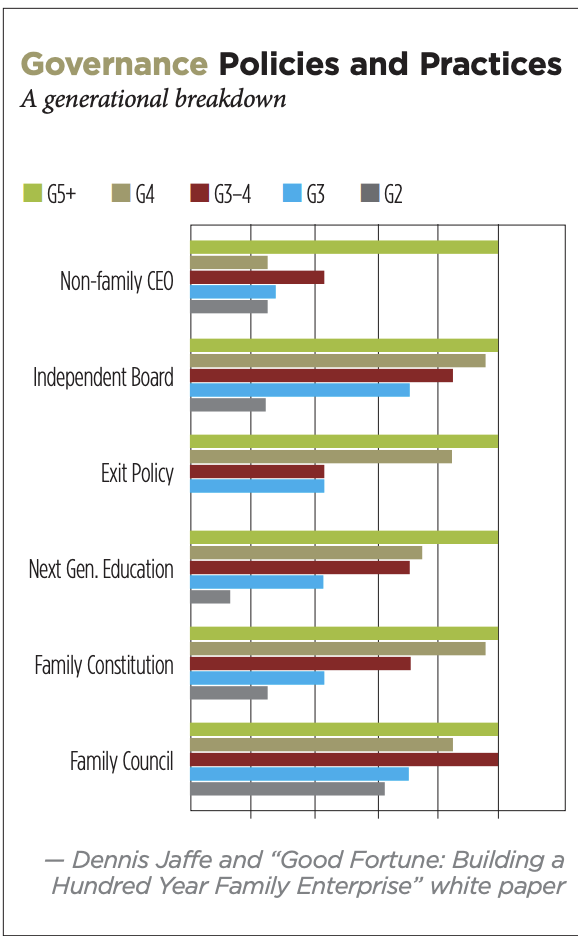
Each family enterprise reaches a point—often by G3—at which they have to take steps to protect and insulate the business from the family. This often takes the form of the development of a board of directors with independent non-family directors, appointed by the family shareholders.
The family develops agreements about the board, family employment, diversifying and sale of assets, leadership succession, and other business activities that have to be somewhat independent of the family, even if the family has a role in them.
Family members who work in the business or who serve on the board must be accountable to the family by developing skills as professionals who are capable of their business roles. The business is the engine that supplied the family with energy for other ventures.
Human Capital Development
Each new generation of family members grows up with expectations of what the family enterprise will offer them. This is entitlement. The generative family understands that accompanying the benefits they receive, they also must develop an ethic that next-generation family members must be responsible, earn a living and develop their own capabilities.
The generative family allocates resources for next-generation education and development. They’re encouraged to find ways to support themselves in their lives, even as they have trust funds and income from the family.
Each generative family has developed education, support, and personal development program for their next generation, and these programs are one very special feature of these families. The family becomes an educational community, where each year, new generation family members get to know each other by participating together in seminars, workshops, and fun learning activities.
They also learn about the family and the service opportunities that will be available to them. One of the more important features of generative families is the learning activities that bring the dispersed members of new generations into contact with their shared heritage and teach them about the opportunities that they can take advantage of.
Family Philanthropy
Generative families have more than they need to thrive. Some next-generation family members grow up feeling a bit uncomfortable with how much they’ll inherit and have as a family. They learn about the inequality of wealth in the world and the great needs that exist and want to use some of the family’s wealth to make a difference.
Each generative family has begun to look at shared philanthropy as another means to sustain family connection and as a proper activity for the next generations. Opportunities to participate in service activities, such as global missions and service projects as they’re growing up and learning about projects the family has supported, lead some family members to become involved in family philanthropy and foundations.
It seems impossible for a generative family to look at what they have and not decide that they can and want to make a difference in the world. Each family has a special path for their family values and legacy as they serve a broader community.
Often, this commitment begins in their family business, where they feel a special bond to their long-time employees and the community in which they work and live.
Qualities of the Generative Family
In hearing the stories of each generative family, we saw that each generation offers a new scenario in the family and business environment. Some challenges can be anticipated, and the family and the business can prepare by creating structures and policies designed to fit the emerging realities.
Either in response to a financial and family succession crisis, or (less frequently) by the foresight of the leaders of the previous generation, our generative families embody the following qualities in the way that they engage the family together:
- Values core: A family business begins with a strong sense of mission and values, at least as a business. To continue into the next generation, the heirs need to affirm, and even develop, their values and commitment to them. To attract succeeding generations to remain part of the enterprise, each generation must renew their values and mission to make being part of the effort meaningful to the emerging generation.
- Resiliency: The generative family and family enterprise are characterized by being adaptable and resilient. No family can avoid tragedy, and no business can avoid a crisis. The successful 100-year family is able to respond constructively to each of the several crises that come their way. Resiliency is a quality that’s been much explored in relation to individuals, families, and businesses. The resiliency and adaptability of the families we met seemed to connect to three qualities that were almost universal. While we don’t know for sure, we believe that while these qualities were common in our group, they’re much rarer and less common in the family enterprises that are less successful and long-lived.
- Transparency: G1 has one founder who’s not accustomed to sharing information, ideas, or control. When a family reaches G2 or G3, however, the siblings or cousins who consider the future need to get up to speed on the key information about the business and the financial agreements. This means that trust documents, business plans, and financials must be shared, understood, and discussed by more family members. Some family members need education about what they mean and what their role is in relation to them. But, information about family enterprise becomes freely available inside the community of the family.
- Cross-generational engagement and collaboration: Siblings learn to fight and argue before they learn to cooperate. Some siblings never learn this lesson. As a family enterprise enters G3, cousins and married-in family members make differences more likely than common ground among family relationships. With scores of relatives, family bonds may not be intimate, but in the families that were adaptable, a shared sense of purpose and commitment to work together in a cooperative and respectful manner had to emerge. Sometimes conflict led branches or individual family members to leave the family enterprise, but each family had to develop an ethic of basic trust, respect, and cooperation to enable them to make difficult decisions.
- Opportunity: The family innovates in ways that offer new opportunities for family members to contribute to the family, not only as business and financial leaders but also as entrepreneurs supported by the family, as social innovators or philanthropists, and in serving the family as a community.
A Positive Narrative
It’s hard to listen to the stories of these 70 families and not feel admiration and respect for what they’ve done. In a time when there’s much concern about the concentration of wealth in the hands of “the one percent,” a study such as this that looks at how these families are making use of their wealth is an important addition to the dialogue.
While this study shouldn’t be taken as an apology for wealth concentration, it does offer a positive narrative. The successful 100-year family isn’t necessarily a selfish group of consumers of excessive luxury goods, but can also be a socially responsible entity, using its vast resources in a responsible way to make a difference in the world.
When we compare the activities of a family enterprise with the activities of a public corporation, we see that the special nature of a family that shares not just resources but also a values-based connection with each other can be of great benefit as we face a harrowing set of global challenges in the next generation.
Become a Member for Your Expertly Curated Advice
Joining the Family Wealth Library means access to the information the legacy builders need to navigate family dynamics and protect our wealth. We can keep what is ours by managing familial challenges and building trust and transparency.
Reprinted with permission from “Borrowed from Your Grandchildren”